Architecting Global Test Systems: Using Test Stand API vs. Custom Sequence Engines in 2026
In the rapidly evolving landscape of global hardware validation, selecting the right test executive architecture is a critical strategic decision. Engineering leaders face a continuous dilemma: leveraging commercial off-the-shelf software like NI Test Stand versus building a proprietary custom sequence engine from scratch using Python, C#, or C++. Using Test Stand API and custom sequence engine architectures presents vastly different trajectories for technical debt, scalability, and long-term financial expenditure. As we navigate the 2026 fiscal year, the shift from monolithic legacy test software to modular, API-driven frameworks is no longer optional—it is a fundamental competitive necessity.
This comprehensive guide explores the multifaceted benefits, drawbacks, and strategic imperatives associated with both approaches, tailored for a worldwide engineering audience. We will analyze total cost of ownership (TCO), license costs, deployment methodologies, and the technical realities of deploying standard software versus bespoke proprietary engines on a global manufacturing scale.
Analyzing the Core Dilemma: Understanding User Pain Points
To make an informed architectural decision, organizations must objectively analyze the persistent friction points associated with both commercial and proprietary automated test frameworks.
The Drawbacks of NI Test Stand
While powerful, a standardized commercial approach introduces specific operational hurdles that engineering teams must strategically mitigate:
- High Licensing Costs: Users frequently struggle with the complex, tiered licensing model. Differentiating between Development Systems, Custom Sequence Execution, Debug Deployment, and Base Deployment licenses creates procurement friction. For large-scale global deployments across multiple manufacturing facilities, the per-seat recurring cost can represent a significant Operational Expenditure (OpEx).
- "Black Box" Complexity: Debugging complex sequences, particularly when troubleshooting custom step types, multi-threaded inter-process communication, or unmanaged DLL calls, is often cited as significantly more difficult than debugging native IDE code (such as Visual Studio or PyCharm). The execution engine can sometimes obscure the root cause of memory leaks or thread deadlocks.
- Version Control Incompatibility: Native sequence files (.seq) are binary or heavy XML files. This structural reality makes diffing, merging, and tracking granular changes in Git, SVN, or Mercurial painful compared to pure text-based code frameworks. While NI provides proprietary diffing tools, they do not seamlessly integrate into modern web-based pull request workflows.
- Vendor Lock-in: Migrating legacy proprietary sequences to a modern, custom-built engine or competing commercial platform is prohibitively expensive and time-consuming. Decades of intellectual property can become locked into a specific vendor's ecosystem, limiting future architectural agility.
- Bloated Runtime Deployment: Deploying the full runtime engine footprint on minimal-resource systems—such as small industrial PCs or embedded controllers—can be excessive. The high overhead is often unnecessary when compared to the highly optimized, lightweight deployment of a custom microservice.
The Drawbacks of Custom Sequence Engines
Conversely, organizations that reject commercial frameworks to build proprietary sequence engines face a different, often more insidious set of challenges:
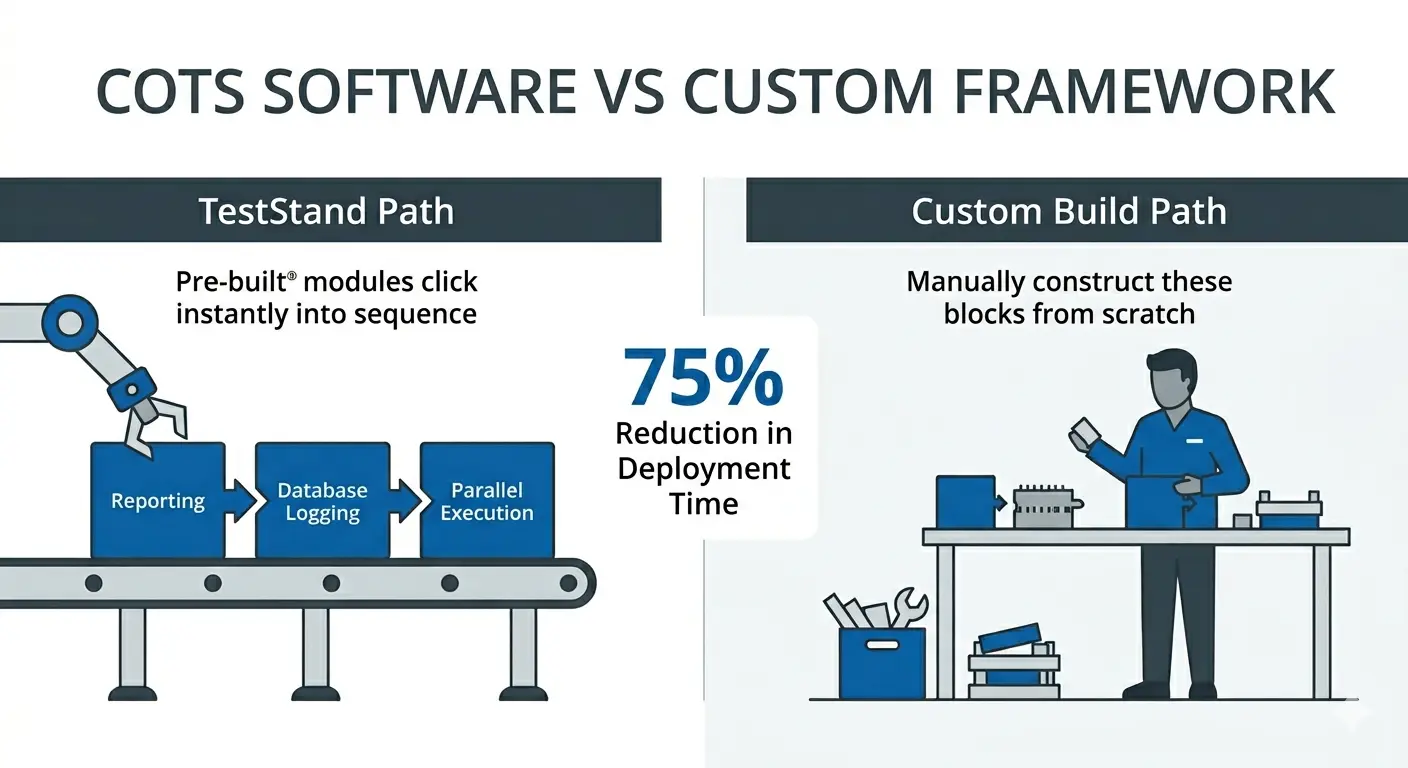
- Crippling Maintenance Debt: Organizations often drastically underestimate the long-term cost of maintaining a custom test framework. Managing dependency hell, updating underlying language frameworks (e.g., migrating from .NET Framework to .NET 8), and adding basic features like parallel execution, HTML/PDF reporting, or database logging consumes thousands of engineering hours.
- Documentation and Training Gaps: Custom frameworks rarely possess the depth of documentation, community support forums, or standardized training courses available for commercial platforms. This leads to critical knowledge silos. When the original framework architects leave the organization, the remaining team is often left maintaining undocumented, specialized code.
- Hardware Abstraction Layer (HAL) Complexity: Building a robust, multi-threaded test engine that accurately handles instrument abstraction, automated test limits parsing, and dynamic measurement reporting requires deep software engineering expertise. These are highly specialized hours that could have been spent on core product development and validation instead of building testing infrastructure.
- Lack of Industry Standardization: Proprietary engines lack the standard "feel" recognized across the test engineering discipline. This lack of standardization makes it difficult to onboard new test engineers, contractors, or system integrators who are already proficient in recognized commercial platforms, thereby extending the time-to-productivity for new hires.
API & Licensing Critical Comparison
When evaluating a commercial platform versus a bespoke internal build, engineering leaders must balance technical capability against financial constraint. The table below outlines the critical differences.
| Feature | Using Test Stand API | Custom Sequence Engine (Python/C#) |
|---|---|---|
| API Architecture | Extensive, highly mature .NET/ActiveX/C++ API. Verbose but proven in high-volume global manufacturing. | Infinite flexibility. Architectures can be explicitly tailored to specific hardware paradigms and workflows. |
| License Costs | Expensive and rigid. Requires continuous subscription or active Software Maintenance Agreements (SMA) for support and updates. | Zero direct software license costs. Total ownership of the intellectual property. |
| Deployment Model | Requires proprietary Deployment Utilities and installation of heavy runtime engines on target test stations. | Typically deployed via standard CI/CD pipelines, Docker containers, or simple installer packages with minimal external dependencies. |
| Extensibility | Architecturally limited to built-in system hooks, custom step types, and defined plugin architectures. | Fully customizable. No architectural ceiling; can natively integrate with emerging technologies like Edge AI inference. |
| Development Speed | Exceptionally fast initial setup for standard test architectures. Slower when forcing highly non-standard custom integrations. | Slow initial setup due to building core infrastructure. Fast execution and deployment once the framework is stabilized. |
The Strategic Imperative: Modernizing Automated Test Architectures
As we progress through the 2026 fiscal cycles, failing to modernize test systems introduces "technical debt paralysis," where the cost of maintaining outdated scripts eventually exceeds the value of the products being tested. Using the Test Stand API as the backbone of your architecture—rather than interacting solely with its graphical interface—provides the agility required for modern manufacturing, balanced against the Total Cost of Ownership (TCO).
1. Deconstructing the Test Stand API: Moving Beyond the GUI
The true enterprise value of a commercial test executive lies not in its standard sequence editor, but in the depth of its underlying API. By programmatically interfacing with core classes—such as the Engine, SequenceFile, Execution, and PropertyObject—software developers can move beyond static, rigid testing.
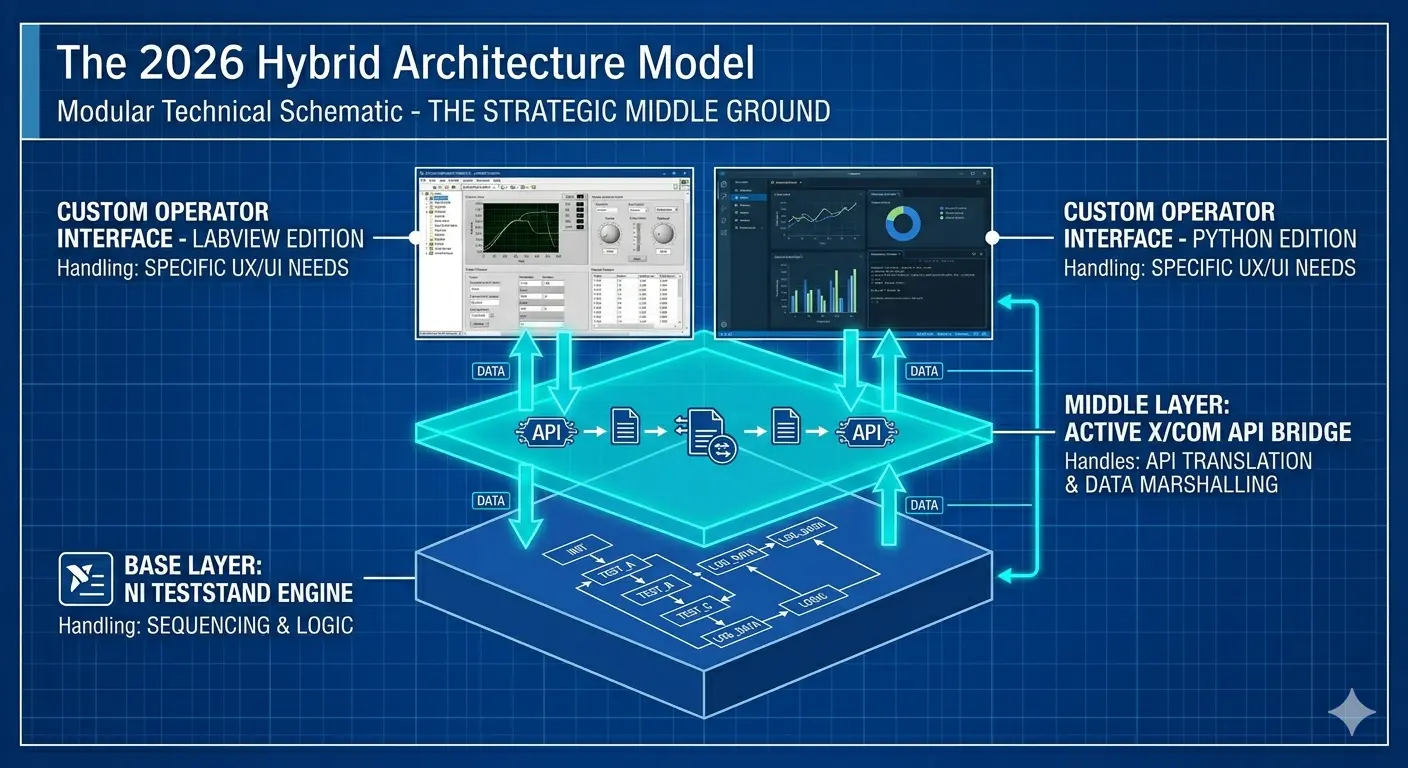
API integration allows for dynamic test generation. For example, a C# or Python application can act as the Operator Interface (OI), quietly spinning up the test engine in the background. Parameters, test limits, and execution flow can be pulled directly from global Product Lifecycle Management (PLM) systems or cloud-based SQL databases in real time. This ensures that the global manufacturing floor is always synchronized with the latest engineering specifications, severely reducing operator-induced errors.
2. TCO Dynamics: Evaluating License Costs as a Strategic Asset
The industry's broad transition to subscription-based licensing models represents a fundamental shift from Capital Expenditure (CapEx) to Operational Expenditure (OpEx) for testing infrastructure. While procurement departments often view this simply as a cost increase, a holistic TCO analysis dictates otherwise.
When accounting for the "hidden" costs of custom legacy systems—specifically manufacturing downtime, lost engineering hours dedicated to custom framework bug-fixing, and the inability to scale software deployments rapidly across international borders—commercial subscription models offer highly predictable scaling. Organizations must evaluate recurring license costs as a form of insurance policy against software obsolescence and unmanaged technical debt.
3. Modular Development and Code Reuse
A primary driver of test engineering efficiency is code reuse across varied product lines. By utilizing the Test Stand API to build a standardized, cross-platform "Wrapper Framework," architecture teams can ensure that up to 80% of the test code (including logging, report generation, instrument communication, and error handling) remains consistent globally. Leveraging a structured API encourages strict modularity, ensuring that underlying library components remain entirely agnostic to the core execution engine, facilitating future-proofed hardware driver integration.
4. API-Driven Data Analytics and Traceability
Modern electronic and mechanical testing produces an ocean of telemetry data. By leveraging the API to customize the Execution object and intercept standard step results, engineers can enable real-time data streaming directly to cloud data lakes (such as Microsoft Azure Synapse or AWS Redshift).
This data-centric approach transforms the manufacturing floor from a simple "Pass/Fail" bottleneck into a vital source of actionable manufacturing intelligence. In 2026, competitive advantage belongs to enterprises that can seamlessly correlate production test data back to initial design simulation models using standard data formats like ASAM ODS or IEEE 1636 (ATML).
5. Navigating the 2024-2026 Licensing Roadmap
Recent evolutions in software licensing structures heavily prioritize team-based access, concurrent execution models, and integrated tiered support. For large-scale global manufacturing, site licenses or concurrent usage models require precise management. It is critical for engineering directors to perform comprehensive software "seat audits" bi-annually to optimize license allocation. Moving away from perpetual node-locked licenses to dynamic, cloud-managed licensing requires a shift in global procurement strategy, positioning active maintenance as the prerequisite for maintaining hardware-software compatibility.
6. Overcoming Technical Debt: A Lifecycle Strategy
Technical debt is the silent killer of factory floor throughput. It rapidly accumulates when test developers bypass the formal API to "hack" unstructured workarounds directly into standard sequence files. To counteract this, organizations must conduct an annual "API Audit" of all deployed sequence files.
If deep, undocumented custom steps or convoluted local variable mappings are discovered, they should be refactored into modular, compiled code modules (DLLs or Python modules) that are cleanly called via the sequence engine. This strict separation of concerns ensures that when underlying platforms upgrade, test assets remain functional without requiring mass validation rewrites.
7. Scaling Through Automation: CI/CD in Hardware Test
The integration of automated test frameworks with CI/CD (Continuous Integration / Continuous Deployment) pipelines represents the modern frontier of hardware validation. By utilizing the API to trigger headless test executions via Git-based commits or pull requests, global teams can automatically validate test software changes against simulated hardware or "Golden Units" in a server rack.
This automated validation reduces the test deployment cycle from weeks to mere hours. When integrated with dynamic license management, these automated CI/CD runners (using platforms like GitLab CI or Jenkins) can be deployed at scale, guaranteeing consistent test execution logic across facilities in North America, Europe, and Asia.
8. Security and Compliance in the Software-Defined Factory
With the rise of Industry 4.0 and increased factory connectivity comes elevated cybersecurity risk. Modern frameworks include tightened security protocols protecting Operational Technology (OT) networks. Proper utilization of a standardized API allows for granular, programmatic control over active directory user permissions.
Compliance with stringent international standards (such as ISO/IEC 17025 for testing and calibration laboratories or FDA 21 CFR Part 11) is vastly simplified when the software framework is configured to automatically cryptographically log every API call, operator login, and parameter modification by default, something custom engines struggle to achieve securely.
9. The ROI of Maintenance: Why Subscriptions Often Win
The true "Total Cost" of a custom test engine includes far more than developer salaries. It encompasses the highly paid engineer's time spent debugging obscure thread incompatibilities or updating legacy hardware drivers. Commercial subscription models, despite their upfront license costs, guarantee that the execution environment continuously receives the latest security patches, OS compatibility updates, and performance enhancements.
Comparing the multi-year cost of a dedicated ten-person internal tools team struggling to maintain a proprietary Python engine versus a streamlined team utilizing a commercially supported, cloud-connected framework, the TCO heavily favors the commercial solution for companies whose primary business is not software development.
10. Building a Future-Proof Global Talent Pipeline
The modern validation engineer is less of a procedural "script writer" and more of a highly skilled "systems architect." Utilizing an industry-standard test platform facilitates vastly simplified global onboarding. By training new hires on standard API utilization, engineers in different geographic regions can become productive within weeks rather than months. Investing in formalized software certifications is not a discretionary HR expense; it is a vital component of infrastructure TCO, minimizing catastrophic human error and maximizing engineering throughput.
Addressing Trending Industry Inquiries on Test Stand
To further clarify the architectural landscape, we must address the most common, data-driven inquiries engineering managers pose when evaluating their test strategies.
Is NI Test Stand worth the cost compared to a custom Python/C# test framework?
For organizations producing high-mix, high-reliability products (such as aerospace, medical devices, or automotive electronics), the cost is almost always justified by the immediate reduction in development time, out-of-the-box parallel testing capabilities, and robust compliance reporting. If your organization's core competency is building specialized software or testing highly unique proprietary protocols, a custom framework may be warranted, but standard manufacturing strongly benefits from commercial off-the-shelf reliability.
Does Test Stand require a runtime license for every deployed system?
Yes. Unlike custom-built proprietary engines which can be distributed freely across thousands of nodes without penalty, commercial platforms operate on per-node or concurrent execution licensing. A Custom Sequence Execution or Base Deployment license is typically required for every physical or virtual machine running the engine on the manufacturing floor. This must be carefully modeled in your OpEx budget.
How does integration compare to building a custom execution engine?
Building a custom engine requires coding standard test executive features from scratch: sequence parsing, multithreading, hardware lock management, variable state management, and report generation. Integrating via an existing API allows developers to bypass these infrastructure tasks and immediately begin writing custom User Interfaces and specific hardware interaction modules. Integration is generally faster, safer, and significantly more reliable.
Can you automate sequences without the full Development System?
Yes. Using the Test Stand API, developers can write lightweight custom operator interfaces (using C#, LabVIEW, or C++) that execute sequence files programmatically on target machines using only a lower-cost runtime or base deployment license. This headless execution model is highly efficient for automated factory floors or CI/CD pipelines where no manual sequence editing is required.
What is the learning curve for standard software vs. building a proprietary editor?
Building a proprietary editor requires senior-level software architecture experience and deep knowledge of UI/UX and compilation theory. Learning an existing commercial API, while complex due to its massive feature set, is significantly faster because the underlying architecture is already proven and exhaustively documented. However, engineers strictly versed in modern web or pure software languages may initially find legacy engineering APIs verbose or counterintuitive.
Are there royalties involved in distributing applications globally?
There are no per-unit "royalties" based on the physical products you test and sell. However, the distribution of the test software itself requires proper software licensing for the target execution machines. You are purchasing the right to execute the engine on a specific node, not paying a royalty on the throughput of that node.
Conclusion: The Path Forward (2026 and Beyond)
As we navigate through 2026, the undisputed winners in the global manufacturing sector will be the organizations that treat their test architecture as a first-class citizen of product design, not as an afterthought. Deciding between a custom sequence engine and utilizing commercial software is a decision that dictates an organization's agility for the next decade.
By leveraging the Test Stand API to enforce rigorous software patterns, strict modularity, and uncompromised data traceability, companies can systematically convert their test engineering departments from reactive cost centers into strategic operational assets. The technology, bandwidth, and edge-computing power required to run these advanced test executives exist today. The true challenge lies in shifting the organizational mindset to fully embrace an API-driven architecture, strategically managing license costs, and relentlessly eliminating technical debt across the global enterprise.